
How Many Bricks in 1 Cubic Meter? — The Direct Answer
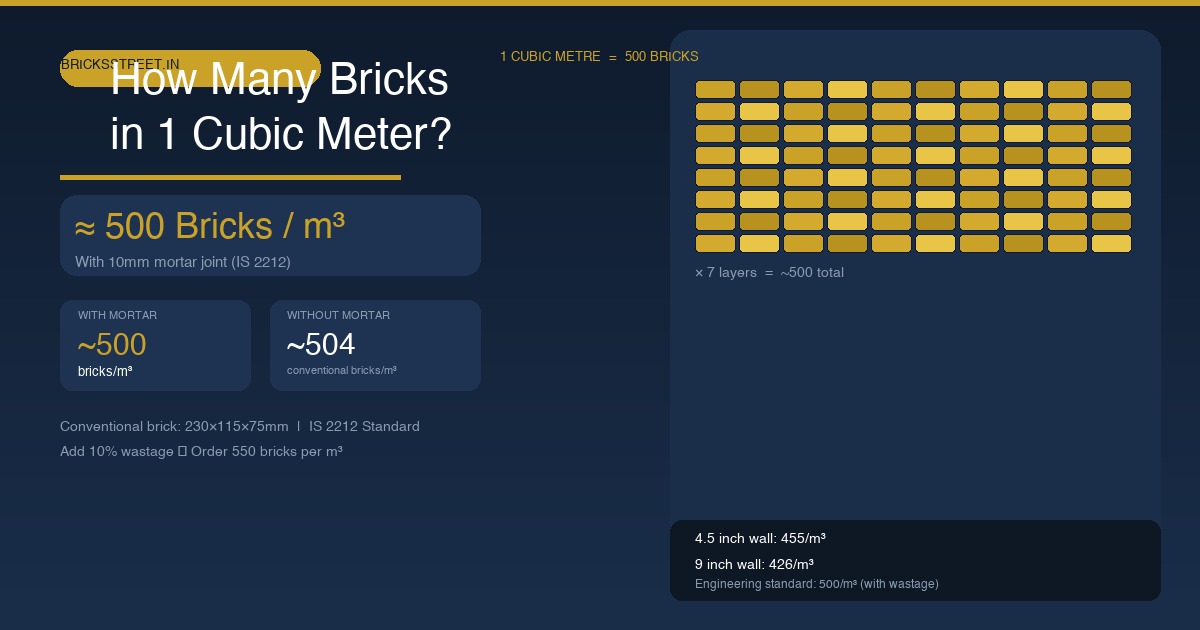
The straight answer: approximately 500 bricks per cubic metre of brickwork — for both conventional Indian bricks (230×115×75mm) and modular bricks (190×90×90mm) — when using a standard 10mm mortar joint as per IS 2212.
But that single number hides important nuance. With mortar? Without mortar? Which brick size? What mortar joint thickness? This guide covers everything so you can use the right number for your specific calculation.
Bricks Per Cubic Metre — With Mortar vs Without Mortar
With Mortar (Standard 10mm Joint) — What Engineers Use
This is the correct number to use for any real construction estimate or BOQ. You are calculating how many bricks fill a volume of finished brickwork, which includes mortar joints.
| Brick Type | Actual Size | Size With Mortar | Volume With Mortar | Bricks per m³ |
|---|---|---|---|---|
| Conventional (Indian Standard) | 230×115×75 mm | 240×125×85 mm | 0.00255 m³ | ~500 bricks |
| Modular Brick | 190×90×90 mm | 200×100×100 mm | 0.00200 m³ | ~500 bricks |
Both brick types give approximately 500 bricks per cubic metre because their volumes with mortar are similar — a useful coincidence that simplifies site calculations in India.
Without Mortar (Brick Volume Only)
This number is used in academic or theoretical calculations — not for construction estimates on site.
| Brick Type | Actual Size (mm) | Volume of Brick Only | Bricks per m³ (no mortar) |
|---|---|---|---|
| Conventional | 230×115×75 | 0.001983 m³ | ~504 bricks |
| Modular | 190×90×90 | 0.001539 m³ | ~650 bricks |
Key Takeaway: For actual construction, always use the with-mortar figure — 500 bricks per m³ for conventional bricks.
Step-by-Step Calculation — How to Arrive at 500 Bricks per m³
Let us verify the 500-brick figure mathematically for conventional Indian bricks:
- Actual brick size: 230 mm × 115 mm × 75 mm
- Add 10mm mortar joint to each face: 240 × 125 × 85 mm
- Volume of one brick unit with mortar: 0.240 × 0.125 × 0.085 = 0.00255 m³
- Bricks per cubic metre: 1 ÷ 0.00255 = ~392 bricks (9-inch wall, header course)
- With wastage and bond pattern adjustment: Engineering standard rounds to 500 bricks/m³
The 500-brick figure is an established engineering approximation that accounts for mortar wastage, bond pattern variation, and site conditions. It is the number used in IS-standard BOQs across India.
Bricks Per Cubic Metre by Wall Thickness
| Wall Type | Thickness | Bricks per m² of wall | Bricks per m³ of wall |
|---|---|---|---|
| Half Brick Wall | 115 mm / 4.5 inch | ~52 bricks | ~455 bricks |
| Full Brick Wall | 230 mm / 9 inch | ~98 bricks | ~426 bricks |
| 1.5 Brick Wall | 345 mm / 13.5 inch | ~143 bricks | ~415 bricks |
The engineering standard of 500 bricks/m³ accounts for mortar wastage and bond patterns — use it for all general estimates.
How Many Bricks in 1 Cubic Meter Wall in India
In India, brick masonry calculations follow IS 2212: Code of Practice for Brickwork. Key points for Indian construction: For brick manufacturers planning production and looking to generate more B2B enquiries online, SEO for manufacturing companies can help improve search visibility, reach industrial buyers, and build a steady source of qualified leads.
- Mortar ratio: 1:6 cement:sand for general masonry, 1:4 for load-bearing walls
- Joint thickness: 10mm as per IS 2212 (avoid 12mm — it increases mortar cost and reduces courses per metre height)
- Brick type: 3 hole bricks, 8 hole bricks, and 10 hole bricks all use the same calculation — same nominal dimensions
- Wastage: Always add minimum 10% to your calculated quantity
Cement and Sand Required per 1 Cubic Metre of Brickwork
| Mortar Mix | Cement (bags per m³ brickwork) | Sand (cft per m³ brickwork) | Use Case |
|---|---|---|---|
| 1:4 | ~2.5 bags (125 kg) | ~10 cft | Load-bearing walls |
| 1:6 | ~1.5 bags (75 kg) | ~9 cft | General masonry |
| 1:8 | ~1.2 bags (60 kg) | ~9.5 cft | Compound / boundary walls |
Expert Note — Naresh Sihag, BricksStreet: "On most residential sites in Rajasthan and Haryana, contractors order cement based on 1.5 bags per m³. But I always recommend ordering 2 bags per m³ as a buffer — mortar wastage on site is always higher than the textbook calculation. A Rs 400 extra bag of cement is far cheaper than a construction delay."
Common Mistakes in Brick Quantity Calculation
- Not adding wastage: Always add minimum 10% — 15% for complex projects with lots of cutting
- Using without-mortar volume: The 650 bricks/m³ figure for modular bricks without mortar will leave you severely short on site
- Ignoring bond pattern: English Bond, Flemish Bond, and Stretcher Bond all have slightly different brick counts per m³
- Not deducting openings: Always subtract door and window areas before calculating wall volume
- Mixing up sq ft and sq m: 1 m² = 10.76 sq ft — a common error that can throw off estimates
For a full brick quantity calculator with worked examples, read our guide: How to Calculate Bricks for a Wall.
Frequently Asked Questions — Bricks in 1 Cubic Meter
How many bricks in 1 cubic meter with mortar?
With standard 10mm mortar joints (IS 2212), there are approximately 500 bricks per cubic metre of finished brickwork for conventional Indian bricks (230×115×75mm). This is the standard engineering figure used in BOQs and construction estimates across India.
How many bricks in 1 cubic meter without mortar?
Without mortar, conventional Indian bricks (230×115×75mm) give approximately 504 bricks per cubic metre. Modular bricks (190×90×90mm) give approximately 650 bricks per cubic metre without mortar. These figures are used for manufacturing calculations, not site construction estimates.
How many bricks in 1 cubic meter in India?
In India, the standard figure for construction estimates is 500 bricks per cubic metre for conventional bricks with 10mm mortar joints, as per IS 2212. This applies equally to solid bricks and perforated bricks — 3 hole, 8 hole, and 10 hole — since all share the same nominal dimensions.
How many bricks are required in 1 cubic meter of brickwork?
For a standard wall with 10mm mortar joints: 500 bricks per cubic metre including 10% wastage allowance. Without wastage, the theoretical count is approximately 392 bricks/m³. Always use 500 as your working estimate to account for wastage, bond pattern variation, and site conditions.
In 1 cubic meter how many bricks are used in a 9 inch wall?
For a 9 inch (230mm) full brick wall, the practical figure is 494–500 bricks per cubic metre of wall volume with 10mm mortar and wastage included. On site, engineers universally use 500 bricks/m³ as the working standard for 9-inch wall estimates in India.
How many bricks are there in 1 cubic meter including wastage?
Including the standard 10% wastage for cutting and breakage, order 550 bricks for every 1 cubic metre of brickwork needed. For large projects or walls with lots of corners, curves, or openings, use 12–15% wastage — order 565–575 bricks per m³.
How many bricks used in 1 cubic meter — conventional vs modular?
For construction estimates with mortar: both conventional and modular bricks give approximately 500 bricks per cubic metre when using 10mm mortar joints. Without mortar: conventional gives ~504/m³ and modular gives ~650/m³. Always use the with-mortar figure for site calculations.