

Standard Brick Size & Mortar Joint — Before You Calculate Anything
If you are building a house, a boundary wall, or even a small room addition, one of the first things your contractor will ask is — how many bricks do you need? Get this wrong and you either run short mid-construction (worst case) or you have a pile of bricks sitting in your compound costing you money.
I have seen both happen. Multiple times.
This guide covers everything — the formula, the math, worked examples for Indian construction. Whether you are working with 3 hole bricks, 8 hole bricks, or 10 hole bricks, the formula is the same — brick dimensions vary slightly but the method does not, how many bricks per square foot for 4.5 inch and 9 inch walls, and even cement and sand quantities. By the end, you will be able to calculate brick quantity yourself, verify your contractor's estimate, and avoid getting overcharged.
Before you pull out your calculator, you need to know what size brick you are working with. In India, two types of bricks are commonly used:
| Brick Type | Nominal Size (with mortar) | Actual Size (without mortar) | Mortar Joint |
|---|---|---|---|
| Conventional / Traditional Brick | 240 × 125 × 85 mm | 230 × 115 × 75 mm | 10 mm |
| Modular Brick | 200 × 100 × 100 mm | 190 × 90 × 90 mm | 10 mm |
The conventional brick (230×115×75mm) is what you will find at almost every construction site in Rajasthan, Haryana, UP, MP, and most of North India — commonly available as 3 hole perforated bricks or solid bricks. The modular brick (190×90×90mm) is more common in South India and in government/IS-standard specifications.
For this guide, most calculations use the conventional brick size unless stated otherwise. Where both matter, both numbers are provided.
One more thing — the mortar joint is 10mm as per IS 2212. Some contractors use 12mm or even 15mm joints (sloppy work, honestly), but the standard is 10mm and that is what we calculate with.
Pro Tip by Naresh Sihag: Always ask your brick supplier to show you the actual brick dimensions before ordering. Sizes vary by kiln, region, and quality. A brick that is even 5mm shorter in length means you will need more bricks per square foot than you budgeted. I have seen estimates go wrong by 8–10% just because of this one oversight.
The Brick Calculation Formula (Step by Step)
There are two ways to calculate how many bricks you need — the volume method and the area method. Both are explained below.
Formula for Number of Bricks
The basic formula is straightforward:
Number of Bricks = Volume of Brickwork ÷ Volume of One Brick (with mortar)
Step by step:
- Calculate the volume of the wall — Length × Height × Thickness (all in metres)
- Calculate volume of one brick including mortar joint — (L + 0.010) × (W + 0.010) × (H + 0.010)
- Divide wall volume by single brick volume
- Add wastage (10–15%)
For a conventional brick with 10mm mortar:
Volume of one brick with mortar = 0.240 × 0.125 × 0.085 = 0.002550 m³
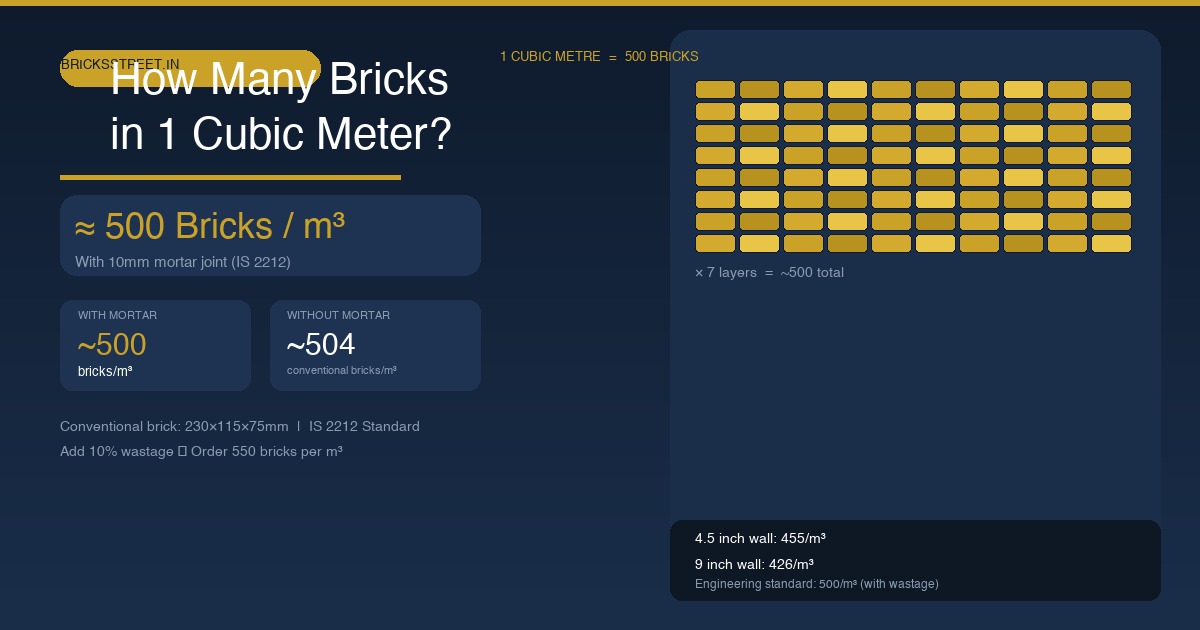
For 1 cubic metre of brickwork:
Number of bricks = 1 ÷ 0.002550 = approximately 500 bricks per cubic metre
For modular brick (190×90×90mm + 10mm mortar):
Volume with mortar = 0.200 × 0.100 × 0.100 = 0.002000 m³
Bricks per cubic metre = 1 ÷ 0.002 = 500 bricks per cubic metre
Volume Method vs Area Method — Which One to Use
The volume method is more accurate. Use it when you know the wall thickness precisely and want a clean, verifiable calculation. It is what engineers use in structural estimates and BOQs (Bill of Quantities).
The area method is quicker. Use it for rough estimates on site or when calculating from a floor plan. You work with bricks per square foot or bricks per square metre for a given wall thickness.
For everyday house construction, most site engineers and experienced contractors use the area method because it is faster. But for a contractor quoting a full project, the volume method is what they should be using. If they cannot tell you which method they used — that is a red flag.
How Many Bricks Per Square Foot?
This is the number most people actually need on site. You know your wall area in square feet, you want to know how many bricks to order. Here is the breakdown:
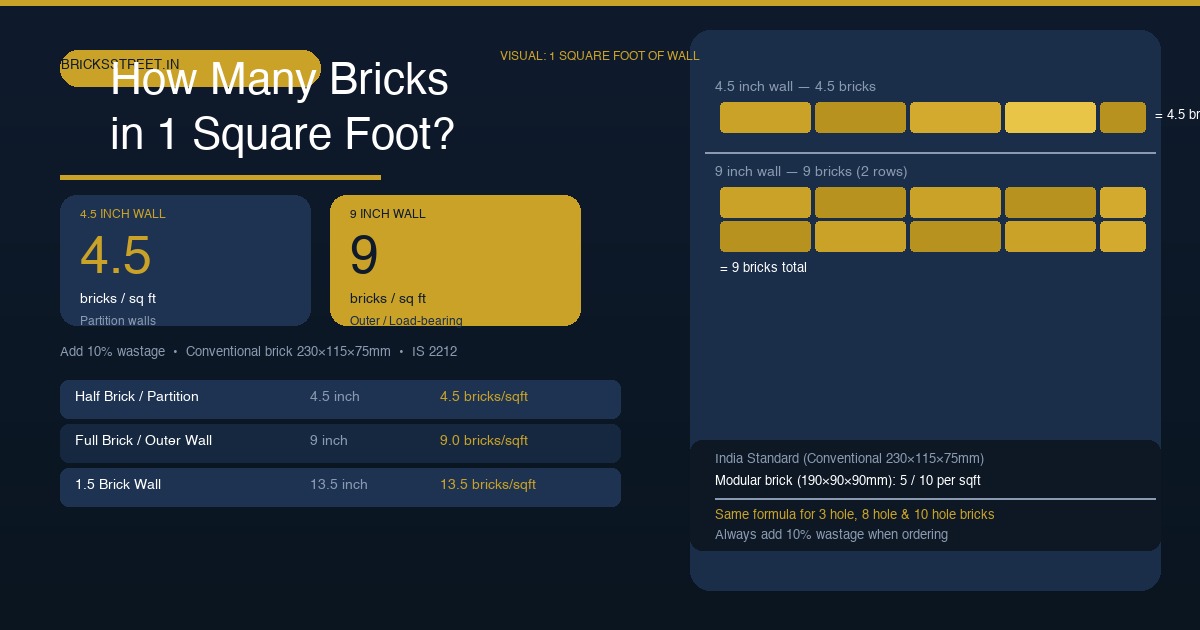
4.5 Inch (Half Brick) Wall
A 4.5 inch wall (also called a half-brick wall or partition wall) is one brick thick standing on its flat face. This is used for internal room partitions, compound walls of smaller buildings, and non-load-bearing walls.
Wall thickness = 115mm = one conventional brick width
For 1 sq ft of 4.5 inch wall:
- Area = 1 sq ft = 0.0929 m²
- Volume of wall = 0.0929 × 0.115 = 0.01068 m³
- Bricks = 0.01068 ÷ 0.002550 = 4.19 ≈ 4.2 bricks
So roughly 4 to 4.5 bricks per square foot for a 4.5 inch wall. Most engineers round to 4.5 bricks/sqft to account for mortar and minor variations.
9 Inch (Full Brick) Wall — How Many Bricks in 1 Square Feet 9 Inch Wall
The 9 inch wall (full brick wall) is the standard for outer walls, load-bearing walls, and any wall that needs strength or thermal insulation. This is one brick thick laid lengthwise — 230mm ≈ 9 inches.
For 1 sq ft of 9 inch wall:
- Volume = 0.0929 × 0.230 = 0.02137 m³
- Bricks = 0.02137 ÷ 0.002550 = 8.38 ≈ 8.5 bricks
So approximately 8.5 to 9 bricks per square foot for a 9 inch wall. On most Indian construction sites, the working number used is 9 bricks per sqft for 9 inch walls.
| Wall Type | Thickness | Conventional Brick (per sqft) | Modular Brick (per sqft) |
|---|---|---|---|
| Half Brick / Partition Wall | 4.5 inch (115mm) | 4.5 bricks | 5.0 bricks |
| Full Brick / Load-Bearing Wall | 9 inch (230mm) | 9.0 bricks | 10.0 bricks |
| 1.5 Brick Wall | 13.5 inch (345mm) | 13.5 bricks | 15.0 bricks |
Pro Tip by Naresh Sihag: In North India — especially Rajasthan, Haryana, Delhi NCR — most residential construction uses conventional bricks with 9 inch outer walls and 4.5 inch inner partition walls. My quick answer is always: 9 bricks/sqft for outer walls, 4.5 bricks/sqft for inner walls. That gives you a fast, reliable estimate for 95% of residential projects.
Worked Examples — Calculate Bricks for a Room Wall
Let's work through real examples. The kind of calculations that actually happen on Indian construction sites.
Example 1: Single Room Wall (10 ft × 10 ft, 4.5 inch)
Scenario: You are adding a partition wall inside a house. Wall is 10 feet long, 10 feet high, 4.5 inch thick. One door opening of 3 ft × 7 ft.
Step 1: Calculate gross wall area
Gross area = 10 ft × 10 ft = 100 sq ft
Step 2: Deduct door opening
Door area = 3 ft × 7 ft = 21 sq ft
Net wall area = 100 − 21 = 79 sq ft
Step 3: Apply bricks per sqft
79 × 4.5 = 355.5 bricks
Step 4: Add 10% wastage
355.5 × 1.10 = 391 bricks → order 400 bricks
Example 2: Full House Outer Wall (9 inch thick)
Scenario: A simple rectangular house — 30 ft × 25 ft (outer dimensions). Wall height = 10 ft. Four walls, 9 inch thick. Three doors (3×7 ft each), six windows (4×4 ft each).
Step 1: Total perimeter
Perimeter = 2 × (30 + 25) = 110 ft
Step 2: Gross wall area
110 ft × 10 ft = 1,100 sq ft
Step 3: Deduct openings
Doors: 3 × (3 × 7) = 63 sq ft
Windows: 6 × (4 × 4) = 96 sq ft
Total deduction = 63 + 96 = 159 sq ft
Net area = 1,100 − 159 = 941 sq ft
Step 4: Calculate bricks
941 × 9 = 8,469 bricks
Step 5: Add 10% wastage
8,469 × 1.10 = 9,316 bricks → order 9,500 bricks
This is the outer wall only. Internal partition walls (4.5 inch) will add another 2,000–2,500 bricks for a typical 30×25 ft house with two internal partitions. For modern RCC frame construction, 8 hole bricks are recommended for infill walls — lighter weight, better insulation, same calculation formula.
How Many Bricks Are Needed to Build a House?
This is the most common question. People planning a new house want a ballpark before they even sit down with an architect. Here is how to think about it.
For standard residential construction in India:
- Outer walls: 9 inch (230mm) conventional brick
- Inner partition walls: 4.5 inch (115mm)
- Wall height: 10 feet (floor to slab bottom)
- Openings: roughly 15–20% of gross wall area
- Wastage: 10–12%
Thumb rule used by experienced contractors across India: for every 100 square feet of built-up area, you need approximately 800–1,000 bricks for single-storey construction. This accounts for both outer and inner walls combined.
1000 Sq Ft House Brick Calculation
Let's take a 1000 sq ft house — a very common size for first-time homebuilders in Tier 2 and Tier 3 cities. Typical layout: 30 ft × 33 ft (approximately), single storey.
Outer walls:
- Perimeter ≈ 126 ft, height 10 ft → 1,260 sq ft gross
- Deduct 18% for openings → 1,033 sq ft net
- 9 inch wall → 1,033 × 9 = 9,297 bricks
Internal partition walls (estimated 120 running feet × 10 ft height, 4.5 inch):
- 1,200 sq ft gross, deduct 15% for doors → 1,020 sq ft net
- 4.5 inch → 1,020 × 4.5 = 4,590 bricks
Total before wastage: 9,297 + 4,590 = 13,887 bricks
Add 10% wastage: 13,887 × 1.10 = ~15,300 bricks
For a 1000 sq ft single-storey house, plan for 14,000 to 16,000 bricks.
1500 Sq Ft and 2000 Sq Ft House
| House Size (Built-Up Area) | Bricks Required (Single Storey) | Bricks Required (Double Storey) |
|---|---|---|
| 600 sq ft | 9,000 – 10,000 | 17,000 – 19,000 |
| 800 sq ft | 11,500 – 13,000 | 22,000 – 25,000 |
| 1000 sq ft | 14,000 – 16,000 | 27,000 – 30,000 |
| 1200 sq ft | 17,000 – 19,000 | 33,000 – 37,000 |
| 1500 sq ft | 21,000 – 24,000 | 41,000 – 46,000 |
| 2000 sq ft | 28,000 – 32,000 | 54,000 – 60,000 |
These are estimates for conventional brick construction with standard openings. Actual numbers will vary based on wall layout, rooms, door/window count, and local brick sizes. Always get a detailed BOQ from your engineer.
How Much Cement Is Required for 1000 Bricks?
Bricks alone are not enough. You need mortar to lay them, and mortar means cement and sand. This is where a lot of homeowners get caught off-guard — they budget for bricks but forget the cement and sand for brickwork.
Cement Quantity Formula for Brickwork
Standard mortar mix for brickwork in India is 1:6 (cement:sand) for internal walls and 1:4 or 1:5 for external/exposed walls.
For 1 cubic metre of brickwork (using 500 conventional bricks):
- Volume of mortar = approximately 0.30 m³ (30% of total volume, as per IS code)
- Dry volume of mortar = 1.3 × 0.30 = 0.39 m³ (mortar shrinks when dry)
For a 1:6 mix:
- Cement = (1/7) × 0.39 × 1440 kg/m³ = 80 kg ≈ 1.6 bags of cement (50 kg bags)
- Sand = (6/7) × 0.39 = 0.334 m³ of sand
For 1000 bricks (= 2 m³ of brickwork):
- Cement required = 3 to 3.5 bags of cement (50 kg each)
- Sand required = 0.67 m³ (approximately 23–24 cubic feet)
Sand Quantity for Brickwork
| Mortar Mix Ratio | Cement per m³ Brickwork | Sand per m³ Brickwork | Cement per 1000 Bricks | Sand per 1000 Bricks |
|---|---|---|---|---|
| 1:4 (external/exposed walls) | 2.2 bags (50kg) | 0.28 m³ | 4.4 bags | 0.56 m³ |
| 1:5 (general brickwork) | 1.9 bags (50kg) | 0.30 m³ | 3.8 bags | 0.60 m³ |
| 1:6 (internal/partition walls) | 1.6 bags (50kg) | 0.33 m³ | 3.2 bags | 0.66 m³ |
When buying sand in India, it is usually quoted in cubic feet. 0.33 m³ is about 11.6 cubic feet. For a 1000-brick job with 1:6 mortar, you need roughly 12 cubic feet of sand.
Pro Tip by Naresh Sihag: Most contractors only quote the brick cost when you ask for an estimate. Always separately ask for cement and sand quantities for brickwork. For a 1000 sq ft house, brickwork alone will consume 45–55 bags of cement just for the mortar — before plastering. That is a significant cost that should be in your budget from day one, not a surprise when the mason asks for more cement.
Quick Reference Table — Bricks Required by Wall Size
For quick on-site reference. All values use conventional brick (230×115×75mm) with 10mm mortar joint and 10% wastage included. Deduct openings from wall area before using these numbers.
| Wall Length | Wall Height | Wall Thickness | Bricks Required (incl. 10% wastage) |
|---|---|---|---|
| 10 ft | 10 ft | 4.5 inch | 495 |
| 10 ft | 10 ft | 9 inch | 990 |
| 20 ft | 10 ft | 4.5 inch | 990 |
| 20 ft | 10 ft | 9 inch | 1,980 |
| 30 ft | 10 ft | 4.5 inch | 1,485 |
| 30 ft | 10 ft | 9 inch | 2,970 |
| 50 ft | 10 ft | 4.5 inch | 2,475 |
| 50 ft | 10 ft | 9 inch | 4,950 |
| 100 ft (boundary wall) | 6 ft | 9 inch | 5,940 |
| 100 ft (boundary wall) | 8 ft | 9 inch | 7,920 |
Wastage Factor & Common Mistakes in Brick Estimation
Under-ordering is a serious problem on construction sites. Here is what causes estimation errors and how to avoid them.
Standard wastage allowance:
- Normal brickwork: 10%
- Curved walls, arches, circular structures: 15–20%
- Transport from kiln (rural areas, kuccha roads): 5% additional
- Machine-made bricks (more uniform, less breakage): 7–8%
Mistake #1: Not deducting door and window openings. Many quotations calculate the full gross wall area without deducting openings. For a house with many windows, this can mean over-ordering by 15–20%. A 3×5 ft window is 15 sq ft — that is 135 bricks for a 9 inch wall you are paying for but do not need.
Mistake #2: Using the wrong brick size. Brick sizes vary by kiln and region. If your supplier's bricks are 220×110×70mm (slightly undersized, common with some local kilns), your calculation based on 230×115×75mm will be off. Measure before you order.
Mistake #3: Ignoring the foundation and plinth. The wall starts from the foundation, not the floor level. If your plinth height is 1.5 feet above ground, those walls also need bricks. Do not calculate only above-floor height.
Mistake #4: Forgetting lintels and bands. Every door and window has an RCC lintel beam above it. For a standard house with 8–10 openings, this accounts for 30–40 sq ft of "wall" area that is actually concrete. Deduct these from your brick calculation.
Mistake #5: Applying single-storey numbers to double-storey. For a G+1 house, you cannot simply double the ground floor numbers. The first floor often has different wall layouts and sometimes 4.5 inch outer walls. Calculate each floor separately.
When you order bricks, typically 3–5% will be broken or chipped on delivery. Always inspect the first load before the full delivery arrives and keep your supplier accountable for replacements.
Frequently Asked Questions — Brick Calculation
How many bricks are needed for 1 square foot of wall?
For a 4.5 inch (half-brick) wall: approximately 4.5 bricks per square foot. For a 9 inch (full-brick) wall: approximately 9 bricks per square foot. These numbers are for conventional Indian bricks (230×115×75mm) with 10mm mortar joints, including 10% wastage allowance.
How many bricks do I need for a 1,000 sq ft house?
For a typical 1,000 sq ft (built-up area) house with 10-foot ceiling height, 9-inch outer walls, and 4.5-inch inner partition walls, you will need approximately 16,000 to 20,000 bricks. The exact number depends on the number of openings (doors and windows) and internal wall layout. Always add 10% extra for wastage — order at least 18,000–22,000 bricks for a 1,000 sq ft house to be safe. Choosing the right brick type matters too: see our guides on 3 hole bricks, 8 hole bricks, and 10 hole bricks.
How many bricks in 1 cubic metre of brickwork?
There are approximately 500 bricks per cubic metre of brickwork for both conventional (230×115×75mm) and modular (190×90×90mm) bricks. This assumes a 10mm mortar joint as per IS 2212. This is the most reliable number to use for engineering estimates and BOQ (Bill of Quantities) preparation.
How do I calculate bricks for a 9 inch wall?
Use the formula: Number of bricks = Wall area (sq ft) × 9. Then add 10% for wastage. Example: A 9-inch wall that is 20 ft long and 10 ft high has an area of 200 sq ft. Bricks needed = 200 × 9 = 1,800 + 10% wastage = 1,980 bricks. Deduct area of any doors or windows before multiplying.
How much cement and sand is needed for 1,000 bricks?
For 1,000 bricks of brickwork in 1:6 cement:sand mortar (standard for masonry work):
— Cement: approximately 1.5 to 2 bags (75–100 kg)
— Sand: approximately 0.25 to 0.30 cubic metres (10–12 cu ft)
For stronger 1:4 mix (used in load-bearing walls), increase cement to 2.5–3 bags per 1,000 bricks.
What is the standard mortar joint thickness for brick masonry in India?
The standard mortar joint thickness in India is 10mm (1 cm) as per IS 2212 (Code of Practice for Brickwork). Some contractors use 12mm joints, but this reduces the number of brick courses per height and slightly increases mortar consumption. Always specify 10mm joints to your mason for consistent, IS-compliant construction.
How many bricks per square foot for a boundary wall?
Most residential boundary walls are 9 inches thick, which requires 9 bricks per square foot. However, if your boundary wall is just 4.5 inches thick (a single-skin wall), then use 4.5 bricks per square foot. For compound walls taller than 6 feet, structural considerations require you to use 9-inch walls with pilasters (thickened columns) every 3 metres as per IS 1905.